The Honest Legal Tech Stack for 2026: What Actually Helps Law Firms Grow?
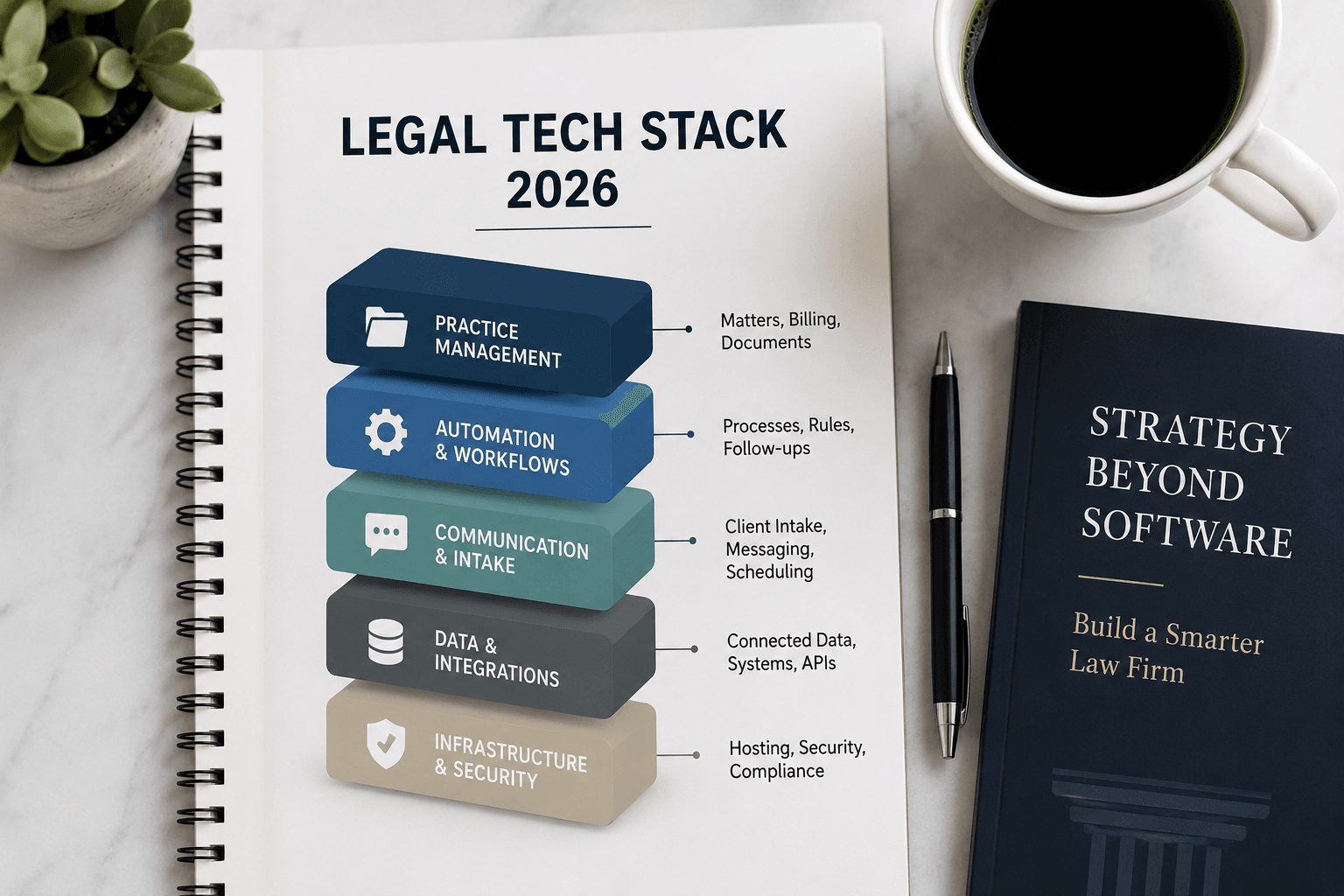
Law firms have never had more technology options. Every year brings new practice management systems, AI tools, automation platforms, communication software, scheduling applications, and workflow solutions promising to make firms more productive. Yet despite the growing number of tools available, many law firms continue to face the same operational challenges:
- Administrative work consumes valuable staff time.
- Systems don't communicate effectively with one another.
- Software costs continue to rise.
- And leadership often lacks visibility into where client data is being stored and processed.
The problem is not a lack of technology, but rather that many firms are evaluating software using the wrong criteria. Traditionally, legal technology is marketed based on features. Vendors highlight dashboards, integrations, AI capabilities, reporting tools, and automation functions. As legal operations become increasingly dependent on technology, firms should begin evaluating software through a different lens, and before adopting any platform, law firm leaders should ask three questions.
First: Who Controls Your Data?
Client information is one of the most valuable assets a law firm possesses. Every intake form, case record, financial document, communication history, and confidential file contains information that clients trust firms to protect. Yet many organizations adopt technology without fully understanding where that information is stored, how it is processed, and who ultimately controls access to it.
This is particularly important as law firms increasingly rely on cloud-based services and third-party integrations to connect their operational systems. The question is not whether cloud technology is inherently good or bad. The question is whether firms have visibility into how their information is being handled and whether their operational infrastructure aligns with their security and compliance expectations.
Second: Does Your Software Become More Expensive as You Grow?
Many legal technology platforms use pricing models that appear affordable at first but become increasingly expensive as firms scale. Additional users, premium features, integrations, workflow volume, and automation activity can all increase monthly software costs over time. For growing law firms, this creates a challenging dynamic. The more successful the firm becomes, the more expensive its operational infrastructure can become.
Technology should support growth, not penalize it. This does not mean every firm should choose the lowest-cost solution. Rather, firms should understand how pricing structures align with their long-term business goals and operational strategy. Predictability matters, the most sustainable technology environments are often built around solutions that allow firms to scale without creating disproportionate increases in operational costs.
Third: Does the Software Actually Do Work?
This may be the most important question of all. Many legal technology platforms are excellent at storing information. They organize case files, manage documents, track billing, and centralize records. These capabilities are important and necessary. However, storing information is not the same as performing work. A truly effective operational system actively moves work forward, it routes information between departments, follows up on missing documents, initiates client communications, schedules appointments, updates record automatically, and eliminates repetitive administrative tasks that would otherwise consume staff resources.
This distinction is becoming increasingly important as law firms search for ways to improve efficiency without continuously increasing headcount. The firms achieving the greatest operational gains are not necessarily adopting more software, they are building systems that reduce the amount of manual work required to operate the firm. Most firms already have some form of practice management software. What many organizations lack is the operational layer that connects systems together and allows information to move intelligently across the business.
Modern legal operations require more than record-keeping systems; they require workflow architecture. The firms leading the next generation of legal services are approaching technology differently. Rather than evaluating tools solely based on features, they are focusing on operational outcomes.
They want systems that:
- Maintain greater control over client data
- Scale predictably as the firm grows
- Reduce administrative workload
- Improve operational visibility
- Connect workflows across departments
- Support long-term modernization efforts
This shift reflects a broader transformation taking place throughout the legal industry. Technology is no longer simply a support function. It has become part of the firm's operational infrastructure. At PraxisFlow, we help law firms design and implement that infrastructure. Our focus is not on adding more software for the sake of technology. It is on building connected, intelligent operational systems that help firms scale efficiently while maintaining visibility, security, and control. Because the most effective legal technology stack is not the one with the most features. It is the one that helps your firm do more work, with less friction, while keeping your operations secure and sustainable for the future.