The Hidden Cost of Outdated Legal Operations: And Why Modern Firms Are Rebuilding Their Internal Systems
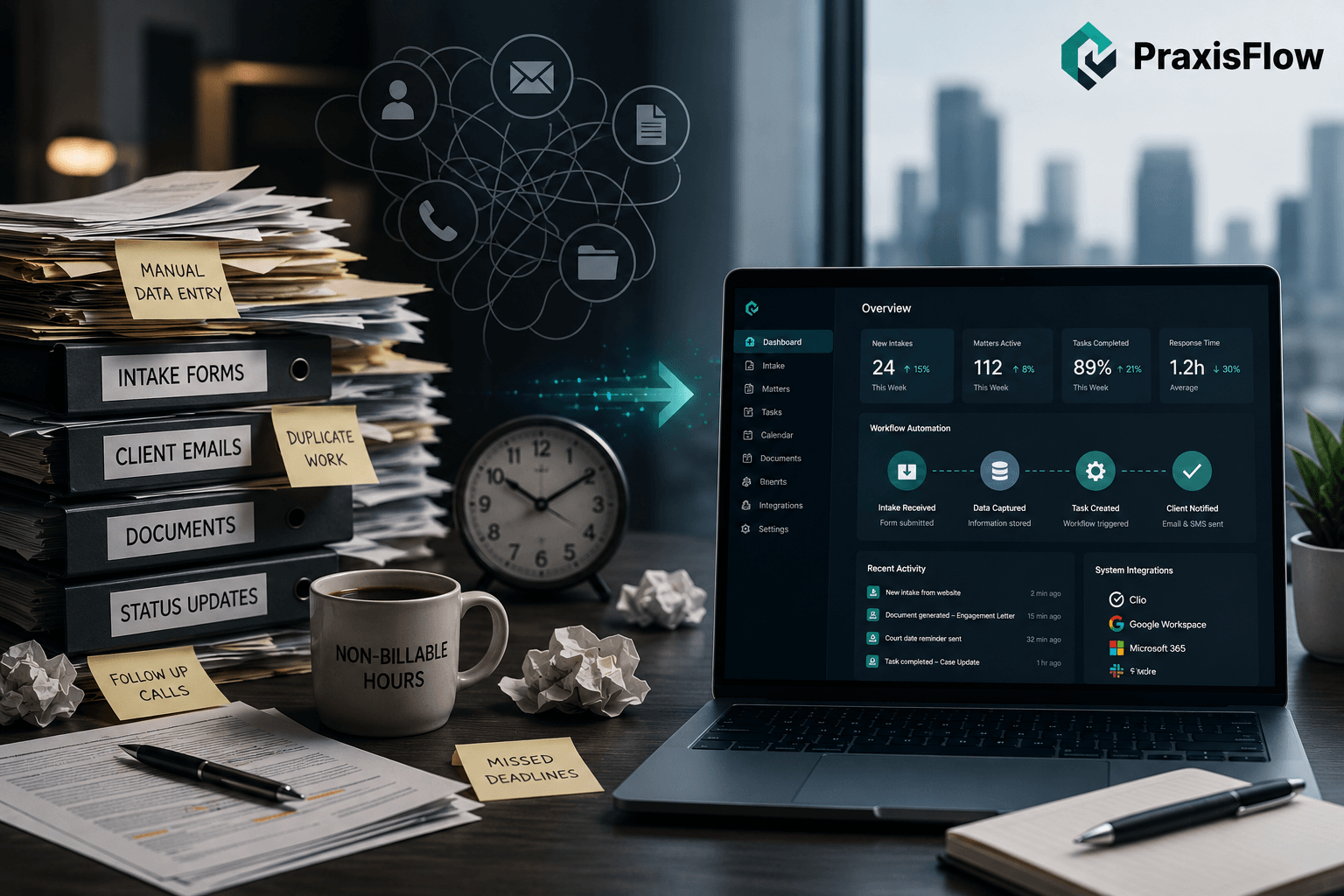
The legal industry has evolved dramatically over the past decade. Client expectations are higher, caseloads are growing, and firms are handling increasingly complex workflows across multiple platforms, communication channels, and departments.
Yet despite this evolution, many established law firms still rely on operational systems built around manual processes.
Email chains replace structured workflows. Intake teams duplicate data entry across multiple systems. Attorneys spend valuable time tracking status updates, searching for documents, or handling administrative tasks that should have been automated years ago.
The result is not just inefficiency. It is operational drag.
And for large firms managing high client volume, operational drag becomes extremely expensive.
The Real Problem Isn’t Staffing, It’s System Design
When firms begin experiencing operational pressure, the instinct is often to hire more staff.
More intake coordinators.
More assistants.
More administrative support.
But adding more people to inefficient systems rarely solves the underlying issue. It simply increases operational complexity. Many law firms today are operating with fragmented internal processes, disconnected software platforms, repetitive manual data entry, inconsistent client communication, outdated approval workflows or duplicated administrative work.
Over time, these inefficiencies compound across the organization. Attorneys become overloaded with non-billable administrative work, support staff spend hours managing repetitive tasks, leadership loses visibility into operational bottlenecks and client response times slow down. The issue is no longer productivity alone. It becomes scalability.
Why Modern Law Firms Are Prioritizing Legal Automation
Forward-thinking firms are now shifting away from isolated tools and focusing instead on operational infrastructure. The goal is not simply “using AI.” The goal is building intelligent systems that reduce friction across the entire firm.
This includes:
- Automated client intake workflows
- Centralized case data synchronization
- Document generation systems
- Automated scheduling and reminders
- AI-assisted communication workflows
- Internal notification systems
- Workflow orchestration between platforms
When implemented correctly, automation does not replace legal professionals. It removes the repetitive operational burden surrounding them. That distinction matters, the most successful firms are not eliminating people, they are enabling their teams to operate at a higher level.
Administrative Friction Is Quietly Reducing Profitability
One of the biggest misconceptions in legal operations is that administrative inefficiency only affects support teams. In reality, operational inefficiency affects every level of the firm.
Consider how much time is lost each week through:
- Manual intake processing
- Duplicated information requests
- Scheduling coordination
- Document retrieval
- Client follow-up emails
- Status update calls
- Internal approval delays
- Switching between disconnected systems
Individually, these tasks seem small, collectively, they consume hundreds of operational hours every month. For large firms, this creates hidden costs that directly impact attorney utilization, client experience, employee burnout, case throughput, operational scalability and revenue efficiency. The firms growing most efficiently today are often not the firms working harder, they are the firms operating with better systems. Many firms already use excellent legal software; the problem is that most platforms operate independently.
A firm may use:
- Clio for case management
- Google Workspace for communication
- Slack for internal collaboration
- Microsoft 365 for documents
- CRM systems for intake
- AI tools for drafting
- scheduling platforms for consultations
But if these systems are not connected intelligently, staff members become the “bridge” between technologies, and that means humans are still manually, transferring data, updating records, sending notifications, creating follow-ups and managing repetitive workflows. Modern legal operations depend on integration. The future of legal efficiency is not about adding more software, it is about creating unified operational ecosystems where systems communicate automatically and securely.
Automation Is Becoming a Competitive Advantage
Clients increasingly expect responsiveness, speed, transparency, and organization from their legal providers. Firms that continue relying on outdated operational structures may struggle to keep pace with firms implementing modern infrastructure.
This shift is especially visible in immigration law, personal injury firms, high-volume litigation practices, corporate transactional practices, multi-office firms and firms managing complex intake pipelines. Operational efficiency is no longer simply an internal matter, it directly influences in client retention, referral growth, online reputation, attorney satisfaction and firm scalability. In many cases, operational modernization becomes a measurable competitive advantage.
The Future of Legal Operations Is Human-Centered Automation
The most effective automation strategies are not designed to remove the human element from legal work, they are designed to protect it. The firms leading the next generation of legal operations understand this clearly, they are investing in systems that allow their teams to focus on the work that truly requires human expertise, everything else becomes optimized, connected, and automated.
Modern legal automation is no longer about convenience, it is about operational resilience, efficiency, and long-term competitiveness. Firms that modernize now position themselves to grow faster, operate more efficiently, and deliver a stronger client experience in an increasingly demanding legal market. The firms that delay modernization may eventually find themselves constrained not by legal talent, but by outdated systems.